
Is Apple Safe Tech?
Is It Even Tech?

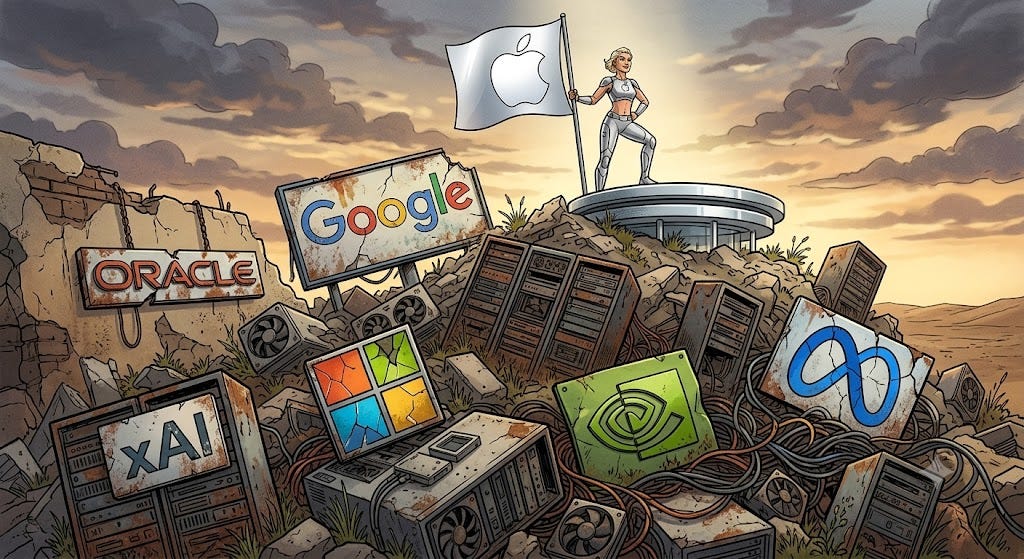
A month ago, I wrote a piece about Apple.
It had a moderately bullish thesis. Apple is the only one of the former Cloud Czars to not go all-in on AI and data centers. Tim Cook’s last big choice was to only deliver AI that could run on Apple clients, and AI remains a server technology.
Since I wrote that piece, Apple stock is up almost 20%. (That’s about $1 trillion, kids.) Apple is nearly the only tech stock I have left in my portfolio. I have slowly dumped them all – Microsoft, Corning, Google, Cloudflare, Nvidia and Taiwan Semi. I even sold VTI, my last pure index fund, because it’s tied to the data center boom.
I’m guess you’ve now concluded I’m buying more Apple.
I’m not. In fact, I’d be more inclined to sell at this point.
Apple is a consumer device maker, worth almost $5 trillion with annual revenues that could hit $450 billion this year, and $45 billion of cash in the bank. It’s a good, strong company. But is any company worth more than 10 times sales in this market, or more than 40 times earnings?
That’s the thing about bear markets. They get everyone, the good as well as the bad. The fact they don’t hit the good as hard doesn’t mean the good don’t get hit. You’ll know this is a real bear market when Apple rolls over.
Meanwhile, where is money going? A surprising amount is going to Europe, where Vanguard’s VGK fund is up almost 15% in the last year. A lot of it is going into bonds, and bond funds, which is why the U.S. 30-year rate has barely budged despite the Trump deficits. I recently picked up some Amazon.Com bonds yielding 6%.
Whither Apple?
Right now, Apple is hunkering down, running in place, doing what it does and, seemingly, innovating not at all. Its engineers are studying AI models, wondering which might be adapted for Siri, and looking carefully at which models its customers are choosing to run.
It’s not exactly paralysis. It’s analysis. Moore’s Law isn’t working, because demand driven by Huang’s Law has overwhelmed it. Parts prices are rising, especially for memory, and Apple is not built for inflation. It’s built for deflation.
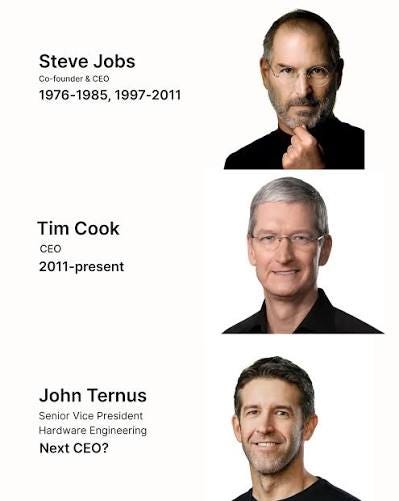
Investors continue to buy Apple stock because it’s the only tech play that looks sustainable, but is it really a tech play? Apple is all about hardware engineering, and incoming CEO John “The Chin” Ternus is a hardware guy. He can use Apple’s advantages in money, manufacturing, and in chip design to deliver high quality gear at prices lower than most competitors and let its software ecosystem make up the difference in value.
But is that a tech company?
Apple has been moving away from tech since Steve Jobs came back 30 years ago. The iPod, the iPhone, the Watch and the Ear Pods are consumer products, not tech products. Comdex is dead, replaced by the Consumer Electronics Show. But the crowd is following it as avidly as it did 40 years ago, when my late friend Tony Bove was publishing Desktop Publishing, even though it’s no longer an innovator but an implementer.
Apple doesn’t lead. It popularizes. The stock is selling because it’s safer than houses, safer in many ways than the U.S. dollar.
Whither Tech?
I’m tired of predicting the end of the data center era. Maybe because it’s here, and I always leave the ball game early (to beat the traffic).
AI will have a purpose, and it will have a value. It will just follow the path of all other tech, rising in value as it falls in cost. Right now, the industry is looking to cut costs, desperately seeking a profit, demanding a softening in prices.
That’s what the data center bust will be about. When it’s over Apple will still be standing. But will it be worth $5 trillion? I doubt it. My own decision is to hold on, take my Apple losses in stride, keep cash close, and buy only when the smoke clears.
There will be bargains. There always are. Just not at a market top.
Prices will fall again. The current price problem is temporary.
Hi Dana, thanks for the great write up! I saw you mentioned that parts prices are rising, especially for memory, and that Apple "is not built for inflation, it's built for deflation," and was wondering if you think operational restructuring, whether in sourcing, manufacturing, or pricing strategy, could meaningfully protect margins here, or if this cost pressure points to a more structural problem with Apple's model as component costs keep climbing.