Cook’s Choice
Will It Kill Apple?

I was going to write about Apple today because they’re the only one of the old “Cloud Czars” that has skipped the data center frenzy.
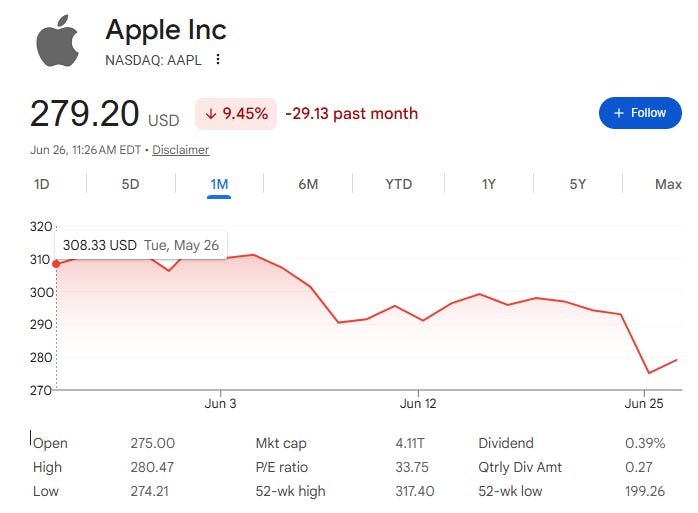
Then the market gave its verdict, thumbs down. The stock lost 6% in a single day, about $250 billion, after competition for memory chips from the data center mob made it raise prices on PCs and tablets. Note that it didn’t raise iPhone prices, but you know margins there are being squeezed by the same chip shortage.
It’s a stupid reason to kick the stock, unless you think that being part of the data center frenzy is essential to competing in the AI world. The Sling thinks it is. They claim Apple’s walled garden has separated it from the market, and it has separated from the server side of the market.
The question is whether that’s the whole market.
Tim Cook made this decision soon after OpenAI began the current era in November of 2022. He saw the new game and said no thanks. It was the biggest decision of his tenure. And I didn’t sell when the bill came due.
The fact is that clients must be the delivery vehicle for AI. By controlling the client, Apple gets some control over the experience. You can get the experience on a PC, oer a tablet, or a Watch.
If Apple has a problem, it’s that buying Apple is like marrying someone. You can’t just buy a Watch and a Windows PC. You’re either in or you’re out. It costs a lot of money to be in and always has, since back when Steve Jobs had hair.
In or Out
I’ve never felt rich enough to be in, so I remain out to this day. I remember missing desktop publishing, desktop video, and HyperCard. This defined my career, pushing me into covering the corporate side of tech, the strategic side, the money.
The problem is that clients aren’t advancing as fast as servers today. Apple can put some Siri functions on the client, but a lot still must go to servers. It can choose a server partner, as it first chose OpenAI and then chose Google Gemini, but those decisions come at enormous cost. Apple is paying $1 billion/year for the new lock-in.
But look at what it’s missing. I’m not the only person who has become convinced the AI bubble will end in tears. Gary Marcus has been writing about the bubble for years, replicating my own journey three decades ago with the dot-com bubble. As the frenzy builds, you start to feel like Cassandra, and you won’t be immune when the bubble pops, either.
The AI Frenzy has now gone so far as to turn Moore’s Law, and Huang’s Law, on their heads. Costs are supposed to decline over time. That’s the bargain. But the demands of tokens and LLM models mean costs are increasing. That’s why Nvidia and Micron are valued as they are.
What we know, however, is at some point this must end. At some point, innovation overwhelms everything, just as it did Microsoft bloatware. I’ve been watching this since the beginning, and it’s not ending. The Nvidia Rubin chip makes the old Hoppers look worthless. IBM has now broken the 1 nanometer barrier in chip design. We already know how Huang broke Moore by pushing innovation to the math processor, and someday soon people will figure out how to program a quantum computer.
Siri-us Question for Ternus
The question remains how AI will come to us. This is the question incoming CEO John Ternus faces.
Client innovation seems to have halted at the Watch and at the voice interface. Apple needs to find something new quickly. That’s because Google has already copied it, as Microsoft slowly copied the Mac’s world.
A sci-fi series I recently finished saw its answer in the “heads-up display,” a visual interface projected above your field of vision. You could talk to it, and it could get answers from its network. The series’ author didn’t anticipate today’s data centers. He relied upon supercomputers to make some displays more powerful than others.
But that’s one way to do it.
Another route is an earpiece like the AirPod, although why Apple hasn’t copied the bone conducting headphones I use on my bike I’ll never know. Something that clips around the ear and sits next to it, connected in turn to a phone and a network, could work wonders alongside a camera that clipped to your glasses instead of replacing them, that you could put in your hair or on your hat the way you put a watch on your wrist.
In this case the phone would act as a server, an interface between these true client devices and the broader network. It could handle a lot of local processing, interpreting what you see and hear, while communicating with clouds in the background. You might wear the whole thing as a badge or as jewelry, like a Star Trek Communicator, only with a camera and that short-range projection system described before.
The point is that Apple still has time, that Apple still has control points, and that the AI game has only begun.