The AI Internet
Refineries of the 21st Century

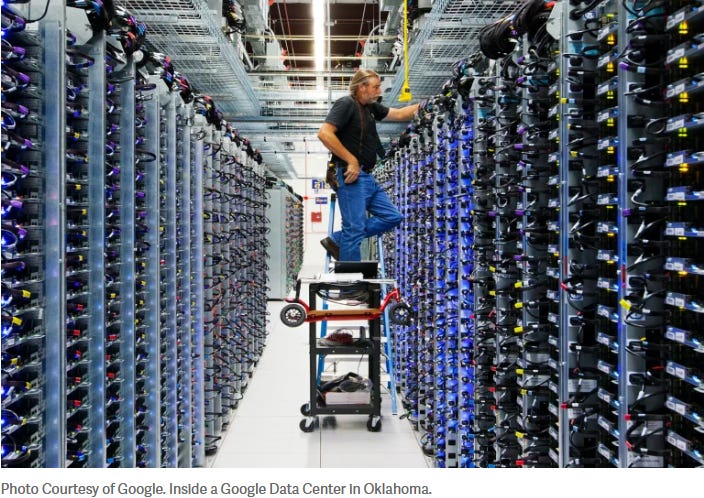
The 1990s brought us the commercial Internet. The 2010s brought us the Cloud Internet.
The 2020s are bringing us the AI Internet.
As with the previous revolutions, the largest players know they must either win this game or die trying. All the cash flow the Cloud Czars – Microsoft, Google, Amazon, and Meta — can scrape up is going into it.
The Cloud Internet was based on cheap chips and low-cost power. The AI Internet is based on Nvidia chips supported by chip memory, fiber cable, and reliable power.
Om Malik has written a great explanation of how it all works. The measure of success is inference, because inference, the translation of questions into answers using AI models, is where the money comes from to support the infrastructure. As opposed to transactions that supported the Cloud Internet and attention that supported the dot-com era Internet.
In previous versions of the Internet, computing happened between clients and servers. To make inference work, most of the AI Internet lives within the Czars’ own infrastructure. To make inference work at scale, fiber fabrics let thousands of Nvidia racks work together. To maintain redundancy and coherence, the Czars are building a new Internet backbone, with faster and fatter fiber cables. Microsoft added 120,000 new miles of this stuff to its network just in the last year. Google, Meta, and Amazon are doing similar things.
The idea is that inference needs can come from anywhere, and go anywhere, often untouched by human hands. Inference is where the money is. Customers are paying for results, not queries. Most of this capacity is going to what I called the Machine Internet back in 2019.
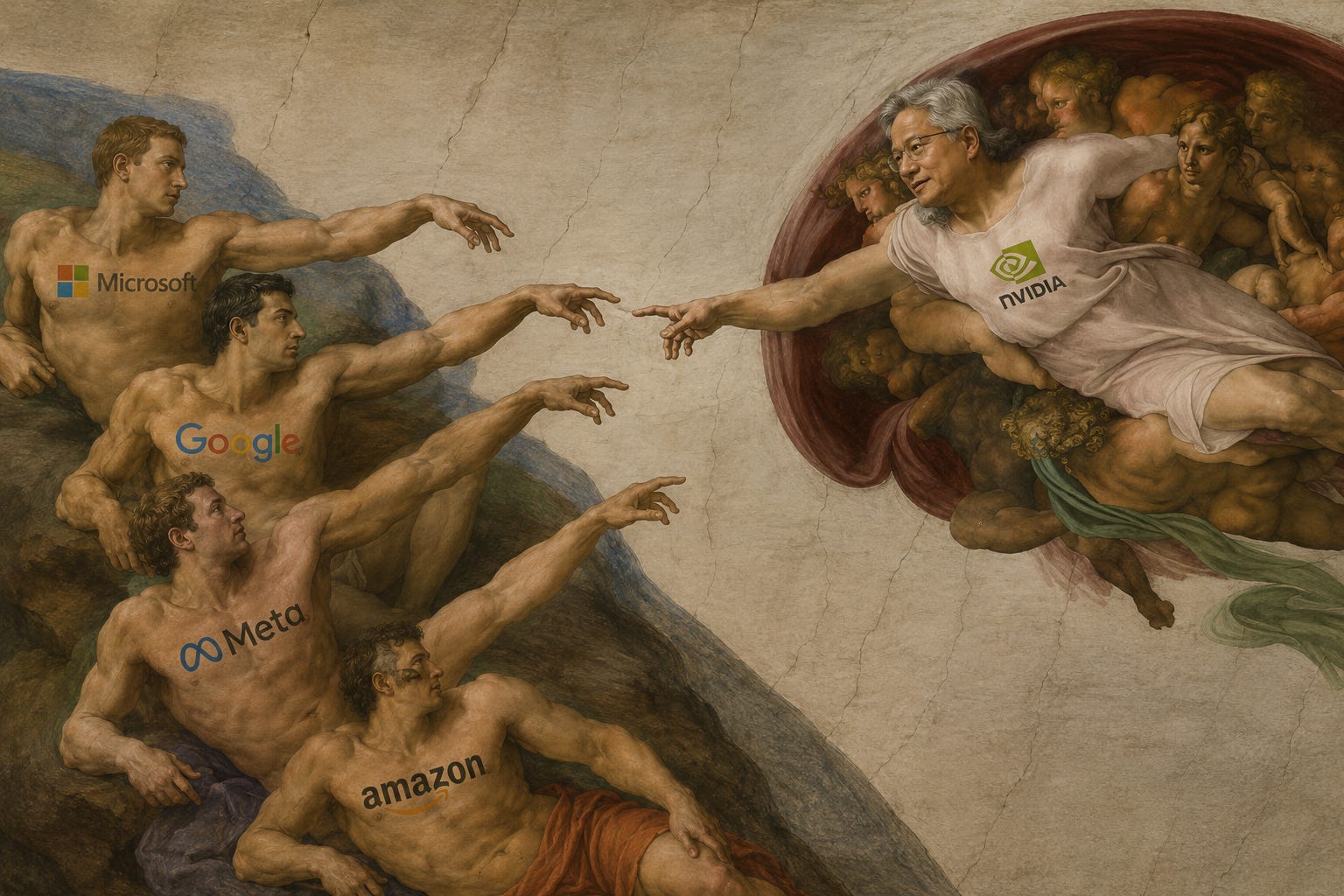
One God Above All Others
The new AI world is like fiber cable itself, both strong yet fragile. For the AI world to work, the world must have peace. Cable cuts and strikes on data centers can take the entire global economy down, because it’s so intertwined with what the Cloud Czars have built.
The biggest mistake the Czars have made is in not understanding this need. They have sought it from political leaders rather than the people. It can take them down and will take down some. (Looking at you, Elon.)
While the Cloud Czars stood alone, the Gods (and “hyperscalers” like Oracle and Coreweave that are copying them) now stand under Nvidia, which supplies them and drives them forward. While the Czars desperately need Nvidia, Nvidia no longer needs them. It’s working on home servers and Nvidia PCs that will let a lot of AI’s work bypass the Czars’ systems entirely. This is being done in the name of redundancy, and of keeping things close to the client, therefore making everything more efficient. It will also make the Czars themselves somewhat redundant.
The Czars’ world looks solid, with software stacks from Anthropic, OpenAI, the Chinese, enterprise software companies, and every enterprise riding inside those data centers. But just as PCs disintermediate mainframes, client systems can disintermediate the Czars.
This resulting AI world looks different than what came before. A lot of it remains nascent. Autonomous transportation, delivery systems, and robots remain at the bleeding edge, as do new types of interfaces to replace today’s phones. But this is where the world is going to change most dramatically, once Nvidia and its customers get it right.
They will get it right.
Beyond the Horizon
Most tech reporters, like most political reporters, and all business reporters, only look at what’s right in front of them. It’s important to get your head up and look toward the horizon, even a little beyond it, if you’re going to know where you’re going.
We’re in the early 20th century of the AI Revolution. No one that I know of is thinking a lot about efficiency, which is necessary to make all this pay off. We’re maximizing our use of energy and tokens when we should be minimizing them. The companies that survive this era, which will end just as the 1920s did, will be those who understand efficiency.
What I mean is there’s still a lot of room for a good hack. There are still enormous needs for engineers of all kinds. Ignore the idiots saying you don’t need college, or that all jobs are going to disappear.
It’s in using AI to turn inference into productivity where the big money will be made over the next decade.