
E-Walking
The Rise of Exoskeletons


I was unable to update my Moore’s Law book because AI created change faster than I could catalog it.
The same might happen to Opa Fiets.
My final section, the E-Transport Revolution, details how a variety of new products are taking e-biking in new directions. They’re faster and more luxurious, adding wheels and storage. E-Bikes are becoming more like motorcycles, more like cars, and this presents challenges to our cities and our laws.
Consumer exoskeletons are about to do the same thing. They will deliver the power of a Boston Dynamics robot under your direct control.
The idea has been around for a decade. Medical exoskeletons already offer help to disabled people who can’t otherwise walk around their apartments, like the Lifeward exoskeleton. Auxivo of Switzerland offers industrial exoskeletons. Seismic, which competes with Auxivo, emphasizes wearability.
But these are expensive products in specialized niches.
What’s new are companies aiming at larger markets. Skip, a Google spin-off, calls its Mo/Jo offering “the world’s first powered clothing.” The DnsysZ1 fits around the knee and makes climbing easier. Its Kickstarter page says it will cost $2,300. Ski Mojo focuses on skiers. Roam Robotics, which started in that niche, is now pushing its leg supports for military use.
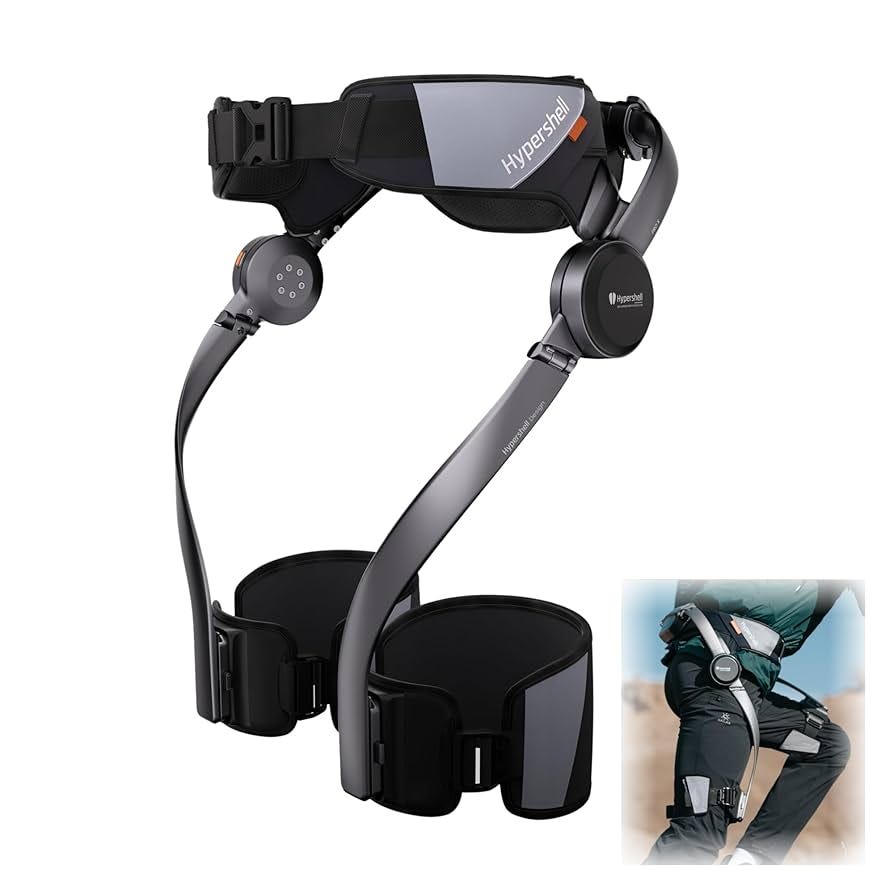
The most interesting to me is the Hypershell X, which calls itself an e-bike for your feet. It’s the price point that gets me. Today Amazon is offering two models, at e-bike prices of $1,600 and $1,100. The Hypershell has motors that are more powerful than those on a conventional e-bike and AI-based software aimed at people who can already walk well, but want to go further and faster. It claims to increase your leg strength by 40% and lets you climb with 30% less exertion.
Early Days
The pitch is attractive, and applications are limited only by your imagination. Imagine a hunter stalking game or burglars running off with your stuff. What happens on the Beltline when people are walking as fast as an e-bike? Imagine ICE coming to your door in these things.
We are still at the e-bike stage of this technology. The listed range on current units is just 10 miles, three hours of walking, just as my e-bike battery can go for 40 miles, or 3 hours of riding. You can’t sit in a car wearing one a Hypershell, but you could sit on a bar stool. The weight is about 5 pounds. The peak power is 800 watts, a little more than a standard Class 3 e-bike motor.
Despite the consumer pricing, it’s unclear how big the current market is. But the idea of an exoskeleton is as flexible as the idea of an e-bike. An upper body model might let an older gentleman shovel his own walk in the winter. A Hypershell would let me ride my Romic much as I do my Edison, giving me the power in my legs that the Edison’s motor puts in my wheels.
Opa Feets, indeed.
WOW!! i could use one now