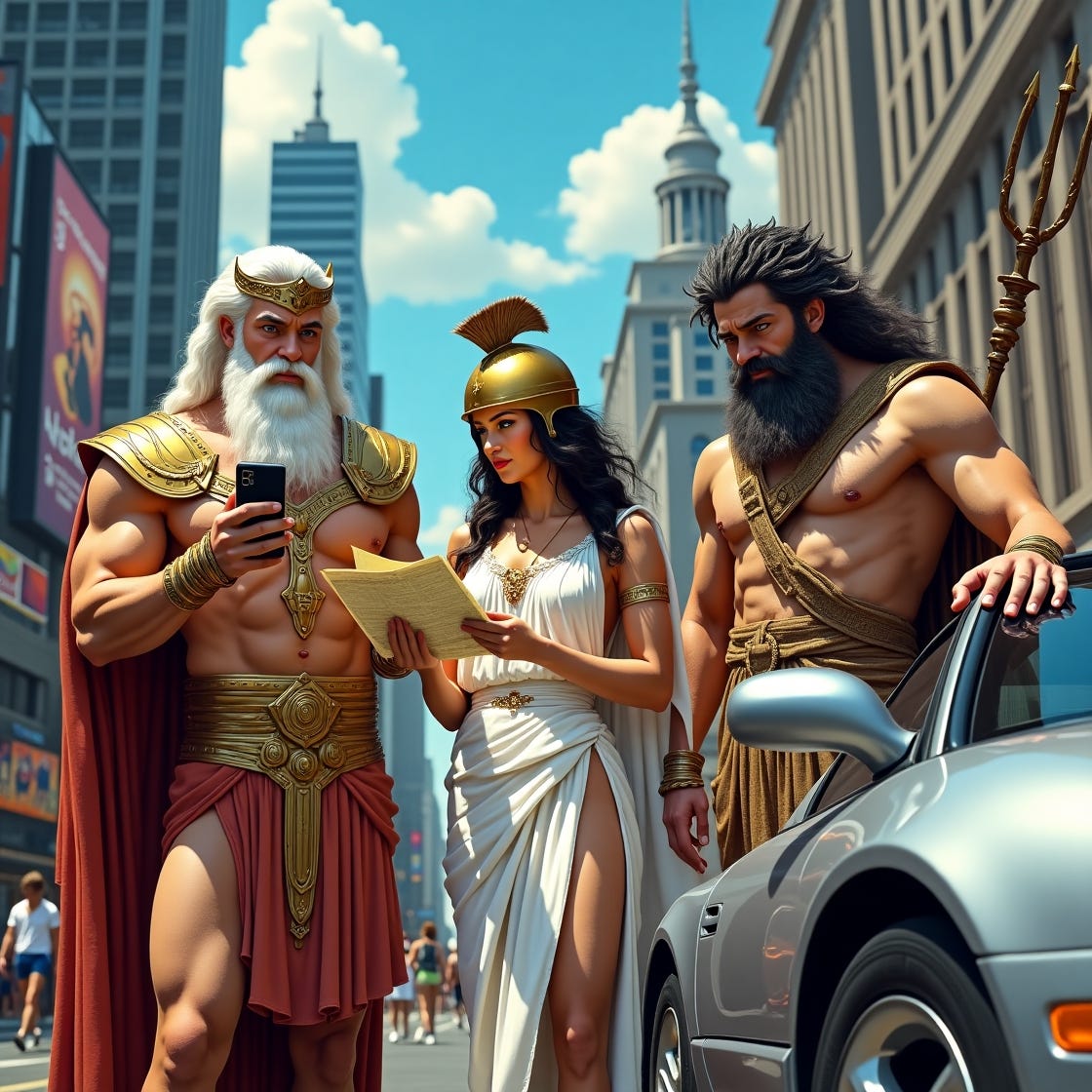
Cauterizing OpenAI
Why the AI Gods Contend in Vain


One of the most audacious efforts in the history of business is now underway.
I call it the “cauterization” of OpenAI.
Everyone now knows what I wrote two months ago. Large Language Models (LLMs) like ChatGPT don’t get better as they get bigger. Putting more garbage in just means getting more garbage out. All this dog poop about “artificial general intelligence” is just that.
The tension is getting to people. Smart people like Marco Fioretti are impatient for the crash. They want to see the whole AI stock complex fail. He compares free AI tools like ChatGPT to alcohol given Indians in the 19th century. (I’d say it’s more like giving them blankets, but you do you.)
Besides, AI is the only thing holding the U.S. economy up at this point. Every other sector of the market is rolling over. Pop this bubble and Trumpworld goes down.
Trouble with that theory is, the AI Gods are onto it. That’s what their cauterization effort is all about. If the coming fall of OpenAI can be made to seem like that of Netscape, rather than America Online, then they feel the boom might continue.
It won’t be easy. OpenAI claims it’s aiming for $1 trillion in annual spending on data centers and Nvidia chips, based on what it claims will be hundreds of billions in annual revenue. OpenAI itself is said to be worth $500 billion. That’s a huge economic wound, a mighty large financial hole that must be filled.
The Plan
Google Gemini is an essential part of this cauterization. Reviews for Gemini 3 have been rapturous. The Verge, which is plugged into the AI Gods’ thinking, now says Google is “winning the AI race.”
But is it really? No. Gemini has just 14.6% of the chatbot market. OpenAI has over 60%. Google is closely paced by Microsoft CoPilot, with Perplexity sitting fourth.
Then there’s the second shoe dropping. The same chart shows Anthropic’s Claude growing even faster than Gemini, at 14% per quarter against Gemini’s 12%. (Yes, the miracle of numbers, which grow faster when they’re smaller.) The point of all this, and in the growth of other models like China’s DeepSeek and Elon Musk’s Grok, is to show that there’s a rich, vibrant market behind OpenAI, and thus its fall would not be so harmful. Who cares if half of it is porn?
Then there’s the Enterprise AI market, where OpenAI is not a major player. This consists of a variety of AI tools being adopted by large businesses around the world. Its “hockey stick” graph shows growth from $31 billion in sales this year to $155 billion in 2030. Note that the Asia-Pacific market will become bigger than North America during that time. (My thought on reading that is, “Buy Alibaba.”)
What these hockey stick graphs are trying to save is another hockey stick, the data center market controlled by Nvidia, where the real money is being spent. The idea is that even if OpenAI falls, and they’re not publicly traded so who cares, we have all these other things that will soak up that compute supply. Don’t worry, be happy.
Will It Work?
The data center hockey stick is unsustainable for reasons well beyond OpenAI.
It demands too much electric power. It demands too much water. More important, it demands too much political stability. Since the current American Administration has abandoned global peace, the only possible result will be other powers rushing to fill the vacuum. China and Europe are now pouring money into arms that could have gone into data centers, while the U.S. prepares to start a host of Vietnams in South and Central America, risking its own stability in the process. Since the next general American election isn’t until 2028 all this instability is inevitable.
Say what you will about AI. It is, at least, a weapon of peace. Yes, it’s economic competition, and yes, it can be applied to war-making. It’s already changing the nature of war, which is another discussion for another time.
But war is unhealthy, not just for economies, but for data centers and other living things. Without peace, more than the AI boom is doomed. Against stupidity, the AI Gods contend in vain.